
Views: 222 Author: Ouye Carton Machinery Publish Time: 2026-05-11 Origin: Site


Automatic stitching machines have revolutionized corrugated box manufacturing by replacing manual labor with precision-engineered automation that delivers superior strength and production efficiency. As someone who has worked extensively with carton packaging equipment at Hebei Ou Ye Carton Machinery Co., Ltd., I've witnessed firsthand how these machines transform raw corrugated sheets into durable, industry-grade boxes that meet the demanding requirements of international shipping and heavy-duty applications. [giantcartonmachine]
The global carton packaging market is projected to grow from $225.38 billion in 2026 to $374.36 billion by 2035, driven largely by e-commerce expansion and sustainability demands. Within this landscape, automatic stitching machines occupy a critical niche—particularly for heavy-duty industrial packaging where structural integrity trumps aesthetic considerations. [towardspackaging]

The fundamental advantage of stitching over gluing lies in how each method bonds corrugated materials. While glue only adheres the outer liner layers together, stitching penetrates through all layers—liners, flutes, and medium—creating a mechanical bond that's substantially stronger. [linkedin]
In my experience providing OEM services to international wholesalers and manufacturers, this strength difference becomes critical for triple-wall corrugated boxes and heavy-load applications where glued boxes simply cannot maintain structural integrity. Military specification (Mil-Spec) applications explicitly require stitching rather than gluing due to both strength and tamper-resistance considerations. [reidpkg]
The trade-off is visual: stitches reduce printable surface area on one corner and create a less polished appearance compared to glued boxes. However, for B2B industrial shipping where performance matters more than shelf appeal, this compromise is negligible. [linkedin]
The automatic stitching process begins with a sophisticated feeding system that ensures dimensional accuracy from the first contact point. The conveyor belt integrates with a suction system that grips corrugated sheets firmly, preventing slippage or misalignment that could compromise final box quality. [giantcartonmachine]
Tension rollers allow operators to adjust belt tightness across different corrugated weights and thicknesses—a crucial feature when switching between single-wall and triple-wall materials. This adjustability is something we emphasize in our OEM designs, as manufacturers often need to run multiple box specifications on the same production line without lengthy changeover times. [giantcartonmachine]
Once sheets enter the machine, the folding belt system executes precise creases that form the box structure. A guide bar then directs each formed box to a correction brush—a component that might seem minor but proves essential for preventing compound errors in high-volume production. [giantcartonmachine]
Modern machines incorporate touchscreen controls that allow operators to input box dimensions and automatically adjust folding parameters. This digital integration represents a significant evolution from earlier mechanical systems that required manual calibration for each specification change. [giantcartonmachine]
The stitching system itself employs specialized rollers that feed flat wire (thread) into the stitching heads at precisely timed intervals. As corrugated sheets pass through, the machine monitors box length in real-time and triggers stitching at predetermined positions based on the programmed specifications. [giantcartonmachine]
What distinguishes automatic systems from semi-automatic variants is the continuous flow—boxes move through stitching without manual positioning or foot-pedal activation. This continuous operation dramatically increases throughput, with modern automatic stitchers processing 30-40 boxes per minute compared to 15-20 for semi-automatic models. [wdcartonmachine]
After stitching, boxes enter a correction station where a pressing device applies controlled pressure to ensure stitches seat properly through all corrugated layers. This pressure application, combined with sensors that monitor stack height, maintains consistency across production runs. [giantcartonmachine]
A critical safety and quality feature is the automatic stop function—if a box jams or ejects improperly, the machine halts immediately and alerts operators to the specific problem area. This prevents damaged boxes from contaminating good inventory and reduces material waste. [giantcartonmachine]
Completed boxes move to a transfer belt system that maintains defined spacing between units—typically 50-100mm depending on box size. This spacing facilitates downstream operations like bundling or palletizing while preventing boxes from crushing each other during acceleration and deceleration. [giantcartonmachine]
Counter sensors track production quantities and can be programmed to trigger automatic batch separations at specified intervals. The touchscreen interface allows operators to adjust count parameters without stopping production, maximizing uptime. [giantcartonmachine]
The final stage involves a bottom stacking system that reinforces the base of each box, ensuring flat stacking and preventing warping during storage. A separate mechanical adjustment device positions boxes correctly on output conveyors, preparing them for immediate use or warehousing. [giantcartonmachine]
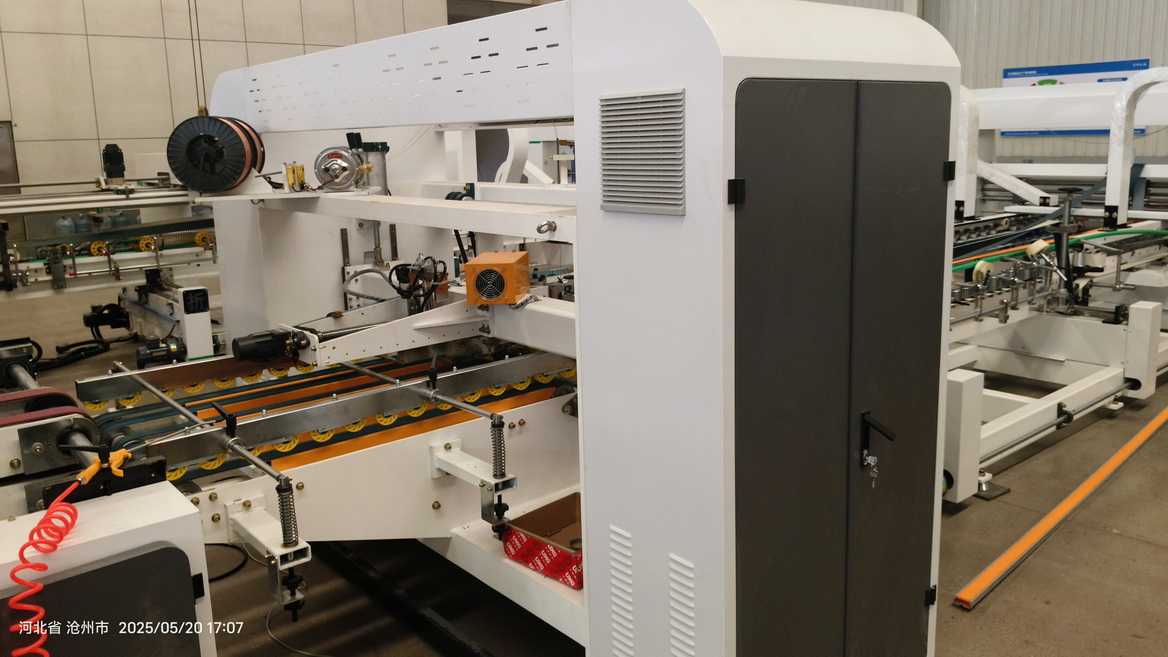
Manufacturing facilities that implement automated carton packing lines report overall equipment effectiveness (OEE) improvements of up to 18% and error reductions of 35%. Labor savings alone can reach $148,680 annually through elimination of manual stitching roles and reduced turnover. [joydatotalpack]
From our perspective as OEM manufacturers, the most compelling ROI factor is production consistency. Manual stitching introduces human variability—some operators stitch tighter than others, break times create production gaps, and fatigue affects quality during long shifts. Automatic machines eliminate this variability, delivering identical stitching tension and positioning on box number one and box number 10,000. [ranpak]
Material handling accuracy also improves dramatically, with automated systems achieving 99.9% accuracy compared to 92-95% for manual operations. This precision reduces waste and ensures customers receive boxes that meet exact specifications. [ublpackaging]
Automatic stitching machines don't operate in isolation—they function as part of integrated corrugated packaging production lines. Upstream processes include printing, slotting, and die-cutting; downstream operations involve bundling, strapping, and palletizing. [linchengpack]
The rise of fit-to-product (FtP) and box-on-demand systems, driven by e-commerce giants like Amazon, is reshaping how stitching machines integrate into production workflows. These systems produce customized box sizes based on exact product dimensions, requiring stitching equipment capable of rapid specification changes without manual retooling. [smithers]
Our OEM approach prioritizes modular design that allows customers to configure stitching machines within their specific production ecosystems—whether that's a high-volume standardized operation or a flexible job-shop environment handling multiple box variations daily.
The corrugated packaging industry's growth is inextricably linked to sustainability trends, with recyclable and biodegradable carton materials increasingly displacing plastic alternatives. Stitching machines contribute to this sustainability profile by using metal wire that's easily separable during recycling, unlike certain adhesives that can contaminate recycling streams. [towardspackaging]
FEFCO Good Manufacturing Practice (GMP) standards govern corrugated box production for food-contact applications, ensuring materials meet EU Regulations 1935/2004/EG requirements. Automatic stitching machines help manufacturers maintain these compliance standards through consistent, documented production parameters that support quality assurance protocols. [fefco]
Asia-Pacific, particularly China, dominates global carton packaging machinery production due to robust manufacturing capabilities and cost-competitiveness. As Chinese OEM manufacturers like Hebei Ou Ye, we serve international customers who require equipment that meets Western quality standards while delivering Asian manufacturing economics. [towardspackaging]
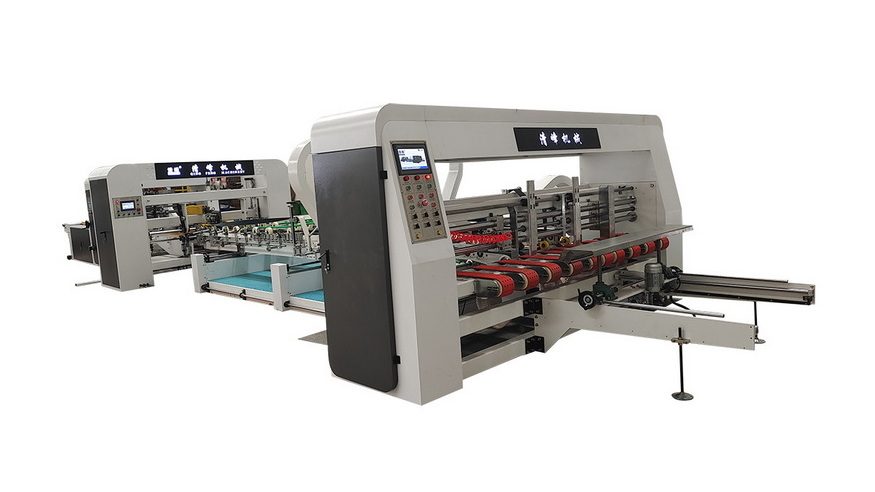
When specifying an automatic stitching machine, several factors determine optimal configuration:
- Box size range: Machines designed for small e-commerce boxes (200-400mm) differ mechanically from those handling large industrial containers (800-1200mm)
- Corrugated wall count: Single-wall boxes require less stitching force than double-wall or triple-wall constructions
- Production volume: High-volume operations (100,000+ boxes/day) justify premium machines with advanced servo controls and predictive maintenance capabilities
- Changeover frequency: Facilities running multiple box sizes benefit from quick-change tooling and digital recipe storage
- Downstream integration: Machines must match speeds and control protocols of existing printing and bundling equipment
Our OEM consultation process always begins with understanding these parameters before recommending specific machine models or custom configurations.
The packaging machinery sector is rapidly adopting Industry 4.0 technologies that enhance both performance and predictive maintenance capabilities. Machine vision systems now monitor stitch quality in real-time, automatically flagging defects and adjusting parameters to maintain specification compliance. [ranpak]
Artificial intelligence enables stitching machines to "learn" optimal settings for new box configurations, reducing setup time from hours to minutes. Predictive maintenance algorithms analyze vibration patterns, motor current draw, and stitch force data to anticipate component failures before they cause downtime. [joydatotalpack]
The corrugated packaging market's projected 5.8% CAGR through 2035 will drive continued innovation in automation technology. As manufacturers face labor shortages and rising wage costs, the economic case for sophisticated automatic stitching systems strengthens considerably. [towardspackaging]
Based on my experience commissioning stitching machines for international customers, several practical factors significantly impact successful implementation:
Operator training: Even fully automatic machines require skilled operators who understand mechanical adjustments, preventive maintenance schedules, and troubleshooting protocols. Budget 2-3 weeks for comprehensive training.
Spare parts inventory: Critical wear components—stitching heads, belts, sensors—should be stocked on-site to minimize downtime when failures occur. We typically recommend 6-12 months of high-wear parts at installation.
Environmental conditions: Dust and humidity affect machine performance. Facilities should maintain clean air circulation and relative humidity between 40-60% for optimal operation.
Power quality: Voltage fluctuations can damage electronic controls. Install voltage regulators or uninterruptible power supplies in regions with unstable electrical infrastructure.
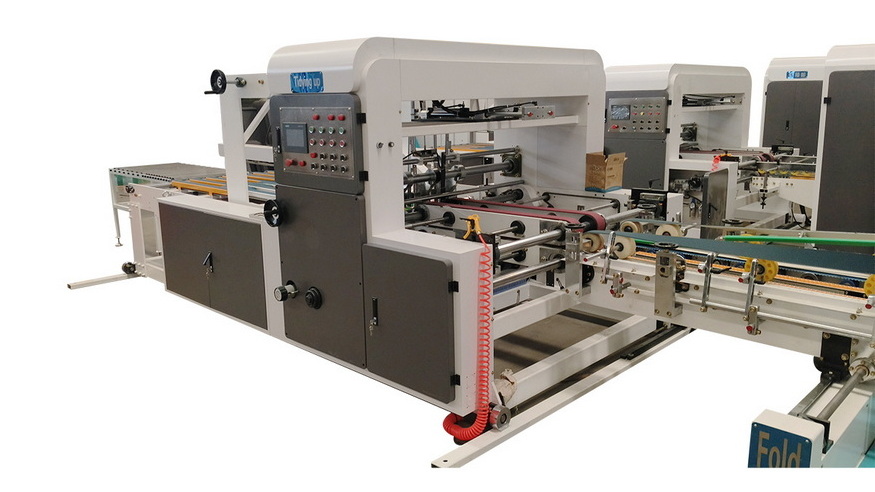
Q1: What's the typical production speed difference between automatic and semi-automatic stitching machines?
Automatic stitching machines process 30-40 boxes per minute in continuous operation, nearly doubling the 15-20 boxes per minute typical of semi-automatic models that require manual positioning between cycles. This speed advantage translates directly to labor cost savings and increased daily throughput. [wdcartonmachine]
Q2: Can automatic stitching machines handle both single-wall and triple-wall corrugated materials?
Yes, modern automatic stitching machines accommodate multiple corrugated wall counts through adjustable tension rollers and stitching force parameters controlled via touchscreen interfaces. However, facilities frequently switching between wall counts should specify quick-change tooling to minimize setup time between production runs. [giantcartonmachine]
Q3: How does stitching strength compare to gluing for heavy-duty applications?
Stitching provides superior strength because the wire penetrates through all corrugated layers—liners, flutes, and medium—creating a mechanical bond, whereas glue only adheres outer liner surfaces. For triple-wall boxes and military specification packaging, stitching is the mandatory assembly method due to this strength advantage. [reidpkg]
Q4: What maintenance schedule should manufacturers follow for automatic stitching machines?
Daily maintenance includes cleaning dust accumulation, checking belt tension, and inspecting stitching wire supply. Weekly tasks involve lubricating moving parts and verifying sensor calibration. Monthly maintenance requires detailed inspection of stitching heads, replacement of worn components, and software backup of production parameters. Preventive maintenance reduces unplanned downtime by 40-50% based on industry data. [joydatotalpack]
Q5: How quickly can manufacturers expect ROI from automatic stitching machine investment?
ROI timelines vary based on production volume and labor costs, but facilities processing 50,000+ boxes daily typically achieve payback within 18-24 months through labor savings averaging $148,680 annually and material waste reduction of 15-20%. Smaller operations may require 30-36 months, while high-volume manufacturers can recoup investment in under 12 months. [ublpackaging]
1. Giant Carton Machine. "Automatic Stitching Machine for Corrugated Boxes Working Principle." Retrieved from https://www.giantcartonmachine.com/automatic-stitching-machine-for-corrugated-boxes-working-principle.html [giantcartonmachine]
2. Lincheng Packaging. "How Automatic Box Stitching Machines Integrate into Corrugated Packaging Production Lines." February 2026. Retrieved from https://www.linchengpack.com/blog/How-Automatic-Box-Stitching-Machines-Integrate-into-Corrugated-Packaging-Production-Lines [linchengpack]
3. Knowledge Sourcing Intelligence. "Cartoning Machines Market: Size, Trends, Forecast 2025-2030." May 2025. Retrieved from https://www.knowledge-sourcing.com/report/cartoning-machines-market [knowledge-sourcing]
4. Towards Packaging. "Carton Packaging Market Size and Trends 2035." December 2025. Retrieved from https://www.towardspackaging.com/insights/carton-packaging-market-sizing [towardspackaging]
5. Phillips, Ward. "Gluing vs Stitching: Which is the better method in corrugated packaging?" LinkedIn, March 2024. Retrieved from https://www.linkedin.com/pulse/gluing-vs-stitching-which-better-method-corrugated-ward-phillips-yt9ke [linkedin]
6. Reid Packaging. "Gluing vs Stitching: Which is the better method in corrugated packaging?" January 2024. Retrieved from https://www.reidpkg.com/2024/02/01/gluing-vs-stitching-which-is-the-better-method-in-corrugated-packaging/ [reidpkg]
7. Reid Packaging. "The Hardest Cardboard: Factors that affect corrugated strength." November 2019. Retrieved from https://www.reidpkg.com/2019/11/24/the-hardest-cardboard-factors-that-affect-corrugated-strength/ [reidpkg]
8. Joyda Total Pack. "ROI of Automated Carton Packing Lines for Small Manufacturers." Retrieved from https://joydatotalpack.com/automated-carton-line-for-small-factories/ [joydatotalpack]
9. UBL Packaging. "A CFO's Guide to Packaging Automation ROI: Quantify Returns." November 2025. Retrieved from https://ublpackaging.com/blog/packaging-automation-roi/ [ublpackaging]
10. Ranpak. "Unparalleled Packaging ROI with AI-Enabled Machine Vision." April 2025. Retrieved from https://www.ranpak.com/machine-vision-insights/ [ranpak]
11. FEFCO. "Standards & Guidelines relating to the corrugated industry." Retrieved from https://www.fefco.org/technical-information/standards-guidelines [fefco]
12. Smithers. "Five trends changing the corrugated packaging market." Retrieved from https://www.smithers.com/resources/2019/jan/trends-changing-the-corrugated-packaging-market [smithers]


