
Views: 222 Author: Ouye Carton Machinery Publish Time: 2026-04-17 Origin: Site


As an OEM carton machinery manufacturer working directly with small and medium carton plants, I've seen many factories stuck between rising quality requirements and limited investment budgets. This is exactly what happened with a small European food packaging carton plant that came to Hebei Ou Ye Carton Machinery Co., Ltd. looking for a practical, affordable upgrade path.
In this article, I'll walk you through how we helped them move from outdated, high-waste equipment to a semi-automatic, high-precision carton printing and packaging line that meets strict European food packaging and environmental standards—without blowing their 50,000 USD budget. If you run a similar carton plant, you can use this as a step‑by‑step reference for planning your own upgrade.
Many small and mid-sized carton factories, especially those focused on food packaging, face a similar set of challenges: [pinlongmachinery]
- Limited capital, making full-automatic production lines unrealistic in the short term
- Increasing customer demands for high‑precision printing and stable color
- Strict environmental standards for food-contact packaging (low VOC inks, certified glues, no metal contamination)
- Lack of in‑house maintenance experts, leading to long downtimes when equipment fails
In the case we'll analyze, the European customer mainly produced small and medium sealed food cartons, with a daily order volume of 2,000–3,000 pieces and a total budget of 50,000 USD for equipment. Their old machines delivered poor print accuracy (≥3 mm deviation) and a 12% scrap rate, which severely eroded profits and risked losing key customers.
From our perspective as an OEM supplier, the starting point was clear: understand the real constraints of the customer, not just sell a machine model.
Key facts:
- Business: Food packaging corrugated cartons (small/medium sealed boxes)
- Region: Europe, subject to stringent food and environmental regulations
- Daily order volume: 2,000–3,000 cartons
- Budget: 50,000 USD (cannot stretch to a full automatic line)
- Pain points:
- Old equipment, poor print accuracy and high scrap
- Cannot reliably meet European food packaging and environmental standards
- No professional maintenance staff
The customer's core questions were very typical of small factories considering semi-automatic solutions:
- "Can semi-automatic equipment really meet our required capacity?"
- "Is the operation simple enough for our existing team?"
- "Can the glue and process meet European environmental and food packaging standards?"
- "What printing accuracy and waste rate can we realistically achieve?"
- "How complicated and expensive is daily maintenance and after-sales support?"
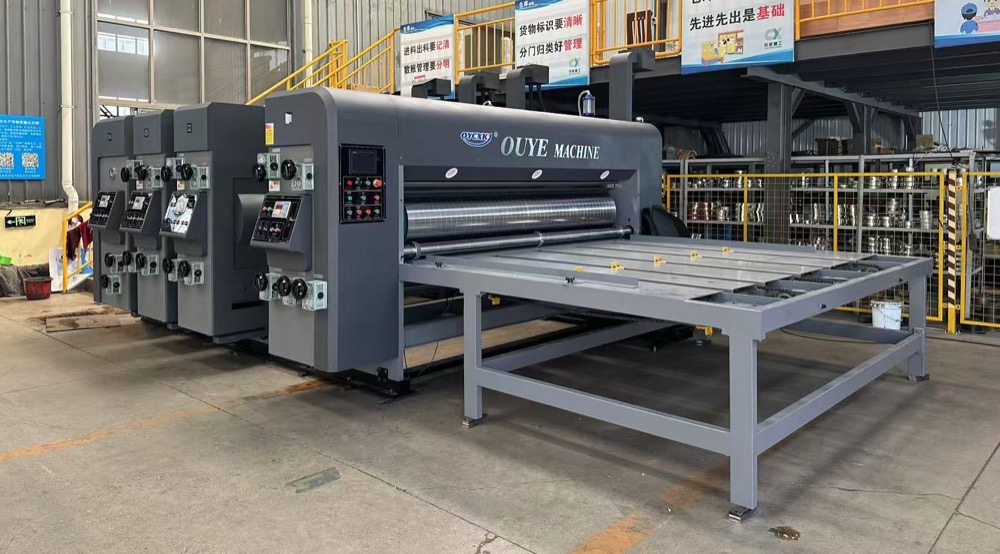
Based on their order volume, budget, and food packaging requirements, we recommended a semi-automatic full set instead of a fully automatic line:
- Semi-automatic printing–slotting–die-cutting all‑in‑one machine
- Environmental gluing machine
- Semi‑automatic stitching (nailing) machine
From an industry practitioner's view, semi‑automatic lines are often the sweet spot for small European factories: [pinlongmachinery]
- Investment control:
- Total equipment investment: about 48,000 USD, staying within the 50,000 USD budget.
- Labor & capacity match:
- Only 3 workers needed (1 feeding, 1 monitoring, 1 collecting), with daily capacity up to 3,500 cartons, exceeding the customer's 3,000-carton demand.
- Compliance & quality:
- Glue system uses Europe-certified environmental glue, with no metal impurities, compliant with European food packaging standards. [hebshenli]
We also provided a similar European small carton plant reference: an investment of 47,000 USD delivering 3,200 cartons per day under comparable environmental standards, which helped build trust.
The heart of the project was upgrading printing accuracy and reducing waste. [pinlongmachinery]
- New semi-automatic printing–slotting–die-cutting line:
- Printing accuracy: ≤ ±2 mm (supported by a precision positioning system).
- Waste rate: controlled within 3%.
- Old line:
- Printing deviation ≥ 3 mm
- Waste rate around 12%.
This difference has a direct cost impact. Taking their current scale as an example:
- Daily orders: 3,000 cartons
- Raw material cost: 0.1 USD per carton
Waste material cost per day:
- Before: 3,000 × 12% × 0.1 = 36 USD
- After: 3,000 × 3% × 0.1 = 9 USD
Daily saving: 27 USD, or roughly 9,855 USD per year just from reduced waste. For a small factory, that's equivalent to recovering a significant portion of the equipment investment within a few years.

After installation and commissioning, the first trial production revealed a very practical issue: color deviation in printing. For food packaging, the customer required uniform color and no obvious color difference between batches.
- Problem:
- Color shift and uneven color density during trial run
- Root causes (diagnosed on site):
- Incorrect ink mixing ratio
- Inappropriate printing pressure settings
Our solution:
- Re‑mixed ink according to the customer's standard color sample
- Re‑calibrated printing pressure
- Conducted a 50‑carton trial run, all samples passing color inspection with 100% color acceptance and no visible color difference
- Delivered on‑site training to their staff on:
- Basic ink formulation methods
- Practical techniques for printing pressure adjustment
We then monitored trial production for the next 2 days, testing color stability every day. The result was a 99% color stability rate, which the customer considered fully acceptable for their brand requirements.
Another common challenge for semi-automatic lines is operator confidence, especially when workers previously only handled older, simpler equipment.
During early use of the gluing machine, employees could not accurately control glue volume:
- Too much glue → overflow, staining cartons
- Too little glue → weak bonding, risk of carton opening
This quickly affected product appearance and bonding strength, and workers were understandably anxious.
Our solution as an OEM partner:
- Adjusted the glue roller settings to match food packaging carton standards
- Added clear glue amount reference scales directly on the machine for visual guidance
- Conducted hands-on training: guided operators through 10 repeated runs until they could accurately control glue volume
- Produced step‑by‑step bilingual operation videos (Chinese + English) so operators could review at any time
After one day of full‑time on‑site guidance, operator proficiency improved significantly. The gluing pass rate increased from 85% to 98%, with no visible glue overflow or bonding failure.
For factories without dedicated maintenance staff, the daily care burden must be low. [ouyecartonmachine]
We designed the solution around that reality:
- Semi‑automatic equipment with simple mechanical structure, easy daily cleaning
- Main items for routine inspection: die‑cutting blades, glue rollers, and other wearing parts
- Estimated monthly maintenance cost: around 200 USD (consumables + small parts).
To address after‑sales concerns, we provided: [ouyecartonmachine]
- Dedicated after‑sales service group with 24/7 remote support
- If remote troubleshooting fails, local European service engineers can arrive on site within 72 hours (we operate 3 service points in Europe)
- One‑year free warranty, including free replacement of wearing parts within the warranty period
- Optional on‑site servicing afterward, charged at a reasonable service fee
Eight months into operation, the customer reported that die‑cut edges became rough, with burrs affecting carton appearance.
We responded as follows:
- Shipped a new die‑cutting blade from a European service center, delivered within 2 days
- Arranged local technicians to come and replace the blade
- Trained operators to check blade wear and replace on their own in the future
- Recommended a routine replacement cycle of every 4 months, suggesting they keep spare blades in stock
After replacement, a 100‑carton trial produced cartons with smooth edges and no burrs, all passing inspection.
Later, the customer landed a large order requiring 5,000 cartons per day, but the original configuration could only deliver 3,500 cartons/day.
Given their reluctance to make another large capital investment, we implemented a targeted upgrade:
- Added an automatic feeding module to the semi‑automatic printing–slotting–die‑cutting unit
- Upgrade cost: about 3,000 USD
- Upgrade time: 1 day
After the upgrade:
- Daily capacity increased from 3,500 to 5,500 cartons
- Workforce increased from 3 to 4 operators
- The factory fulfilled the large order on time, achieving 100% on‑time delivery
- The incremental profit from that order alone was around 8,000 USD
From an expert's point of view, this illustrates an important strategy for small plants: start with a lean semi‑automatic configuration, then add targeted automation modules as order volume and cash flow grow, instead of over‑investing upfront.
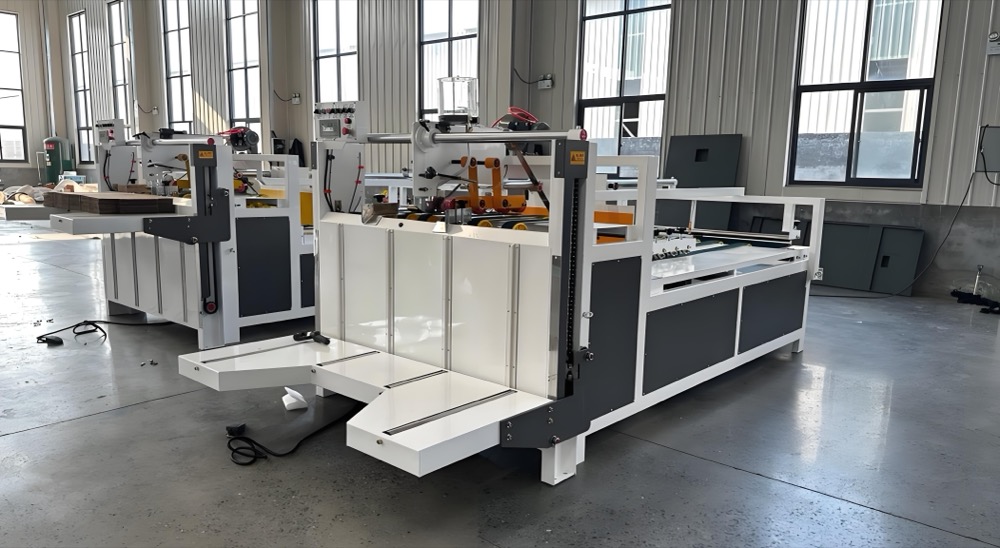
The table below summarizes the main changes before and after the upgrade:
| Item | Before Upgrade | After Semi-Auto Line |
|---|---|---|
| Daily order volume | 2,000–3,000 cartons | 3,500–5,500 cartons (after upgrade) |
| Printing accuracy | ≥ 3 mm deviation | ≤ ±2 mm precision |
| Waste rate | ~12% | ≤ 3% (stable at ~2.8%) |
| Daily raw material loss | 36 USD | 9 USD |
| Annual raw material savings | – | ≈ 9,855 USD |
| Number of operators | Similar or more, low efficiency | 3–4, with higher output |
| Environmental compliance | Unstable, old equipment | Uses certified eco-friendly glue |
| Main investment | – | About 48,000 USD + 3,000 USD later upgrade |
| After‑sales support | Limited | 24/7 remote + 72‑hour on‑site in Europe |
Drawing from this and other projects, here are practical selection guidelines for carton factories considering semi‑automatic equipment: [pinlongmachinery]
1. Start from orders, not machines
- Calculate daily and peak order demand first.
- Ensure configured capacity exceeds demand by at least 15–20% to handle surges.
2. Align investment with realistic payback
- Estimate how many years of waste reduction + added profit will repay the equipment.
- For many small plants, semi‑automatic solutions hit the best balance between ROI and flexibility.
3. Don't ignore after‑sales capability
- Check if the supplier has local service points or stable partners.
- Confirm response times and warranty details in writing.
4. Focus on operator training
- Ask for on‑site training + operation videos + manuals.
- Ensure the machine interface and adjustment methods are clear enough for your existing team.
5. Plan for future upgrades
- Ask which modules can be added later (automatic feeding, automatic stacking, inline strapping, etc.).
- Think of your line as upgradeable, not fixed.
Hebei Ou Ye Carton Machinery Co., Ltd. is a Chinese factory specializing in carton printing machines and carton packaging equipment, providing OEM service to overseas brands, wholesalers, and manufacturers. What differentiates us in projects like this is not only the machine, but the complete solution mindset: [youtube]
- Full range of carton machinery:
- Carton printing machines, printing–slotting–die‑cutting combinations, gluing and stitching machines, and related packaging equipment. [ouyecartonmachine]
- OEM and customization:
- We tailor specifications, configurations and colors to brand owners, large distributors, and regional agents.
- Case‑driven engineering:
- We actively document global cases (like this European food carton plant and our Romanian fully automatic line project) and use them to design better solutions for new clients. [ouyecartonmachine]
If your factory is in a similar position—limited budget, but facing tough quality and compliance demands—a well‑designed semi‑automatic line is often the fastest path to stable, profitable growth.
If you are a carton factory owner, overseas brand, wholesaler, or packaging producer considering an upgrade, you can take these steps:
1. List your daily orders, maximum peak orders, and carton sizes.
2. Clarify your target markets and environmental standards (e.g., food-grade, EU regulations).
3. Share your existing equipment photos and workshop layout.
Our engineering team can then design a tailored semi‑automatic or mixed automatic line with clear investment, capacity forecasts, and a step‑by‑step upgrade roadmap.
To discuss your project or request similar case details, contact Hebei Ou Ye Carton Machinery Co., Ltd. via our official channels. [facebook]
Yes. When configured correctly with certified environmental glue, low‑VOC inks, and precise process control, semi‑automatic equipment can fully meet European food packaging standards. In this case, the gluing system used Europe-certified glue with no metal impurities, and the production process was validated by sample testing before contract signing. [hebshenli]
For a similar configuration (printing–slotting–die‑cutting all‑in‑one + gluing + stitching), 3 operators are enough for about 3,500 cartons/day. After adding automatic feeding, a fourth worker can push capacity to around 5,500 cartons/day.
It depends on your order volume and selling price, but in this European case, the customer saved about 9,855 USD/year just from reduced waste, plus additional profits from new orders. Combined with higher output and fewer customer complaints, many small plants see a reasonable payback period within several years.
The design emphasizes simple structure and easy maintenance, plus systematic after‑sales support. Our team provides 24/7 remote troubleshooting, and if remote support is insufficient, local European technicians can arrive within about 72 hours, backed by a one‑year warranty and ongoing service options. [ouyecartonmachine]
Yes. A core advantage of this approach is that you can start with semi‑automatic and add modules later (automatic feeding, stacking, etc.) as orders grow and cash flow improves. In this case, a 3,000 USD automatic feeding upgrade raised capacity from 3,500 to 5,500 cartons/day with minimal disruption. [pinlongmachinery]
1. Hebei Ou Ye Carton Machinery Co., Ltd. – Internal case document: European small food packaging carton plant semi-automatic line project
2. OUYE official case page – "Case" section with global carton machinery projects, including Romania and South China references. <https://www.ouyecartonmachine.com/case.html> [ouyecartonmachine]
3. OUYE Carton Machinery – YouTube channel showing carton printing, slotting, and die-cutting equipment in operation. <https://www.youtube.com/watch?v=kh3hLFocXvw> [youtube]
4. Facebook page "OU YE Carton box machinery" – Product highlights and application scenarios for multi-color printing and die-cutting machines. <https://www.facebook.com/100089204242086> [facebook]
5. Case studies on printing–slotting–die‑cutting machines in packaging production – "Case Studies: Successful Uses of Printing Slotting Die Cutting Machines". <https://www.pinlongmachinery.com/article/detail/case-studies-successful-uses-of-printing-slotting-die-cutting-machines.html> [pinlongmachinery]
6. Overview of European carton machinery and environmental compliance requirements for food packaging. <https://www.hebshenli.com> [hebshenli]


