
Views: 237 Author: Wynne Publish Time: 2026-11-24 Origin: Site


Content Menu
● 1. Start with Raw Material Inspection Before Carton Production
>> Check Corrugated Board Thickness and Structural Strength
>> Inspect Paper Quality and Adhesive Performance
● 2. Control Every Critical Stage of the Carton Manufacturing Process
>> Flexographic Printing Quality Control
>> Slotting, Creasing, and Die-Cutting Inspection
>> Folding and Gluing Quality Control
>> Stitching and Final Assembly Inspection
● 3. Use Standardized Testing to Verify Carton Performance
● 4. Understand How Carton Machinery Affects Finished Box Quality
>> Why Machine Stability Matters More During High-Volume Production
● 5. Establish a Practical Quality Control Workflow for Carton Factories
>> Step 1: Review the Customer's Technical Requirements
>> Step 2: Conduct Incoming Material Inspection
>> Step 3: Complete Machine Setup and First-Article Inspection
>> Step 4: Perform In-Process Sampling
>> Step 5: Conduct Final Inspection and Batch Release
>> Step 6: Record Results and Implement Corrective Actions
● 6. Reduce Quality Risks When Upgrading a Carton Production Line
● 7. Build a Continuous Improvement System for Long-Term Quality Consistency
● Conclusion: Consistent Carton Quality Starts with Controlled Production
● Frequently Asked Questions About Quality Control in Carton Packaging
>> 1. What are the most important factors in carton packaging quality control?
>> 2. Which tests are commonly used to evaluate corrugated box quality?
>> 3. How does carton printing machinery affect packaging quality?
>> 4. How can manufacturers reduce defects during carton production?
>> 5. Why is machine maintenance important for carton quality control?
>> 6. What should manufacturers consider when purchasing carton packaging machinery?
>> 7. Can an automated carton production line improve product quality?
Quality control in carton packaging is not simply about checking whether a finished box looks good. It involves controlling every stage of production, from corrugated board selection and printing to slotting, die-cutting, folding, gluing, and final inspection.
For corrugated box manufacturers, even a small production deviation can lead to inconsistent box dimensions, poor printing registration, weak adhesive bonds, or insufficient stacking strength. These defects may result in customer complaints, product damage during transportation, material waste, and unnecessary production costs.
From a manufacturing and production engineering perspective, consistent carton quality depends on three interconnected factors: suitable raw materials, stable production processes, and reliable carton packaging machinery.
This guide explains how to establish an effective carton packaging quality control system, identify common production defects, select appropriate testing methods, and improve quality consistency through better equipment management.
Raw material quality determines the foundation of the finished carton. Even advanced carton packaging machinery cannot completely compensate for inconsistent corrugated board or unsuitable paper materials.
Before production begins, manufacturers should establish clear incoming material inspection procedures.
Different packaging applications require different board structures.
For example, lightweight e-commerce cartons may prioritize material efficiency, while heavy-duty industrial packaging requires greater compression resistance and structural stability.
Important inspection items include:
- Board thickness: Check whether the measured thickness meets the specified requirements.
- Edge Crush Test (ECT): Evaluate the board's resistance to compression applied along its edge.
- Bursting strength: Assess the board's resistance to pressure that may cause rupture.
- Flat Crush Test (FCT): Evaluate the resistance of corrugated flutes to crushing.
- Moisture content: Identify excessive moisture that may affect board strength and dimensional stability.
Manufacturers should define acceptance criteria according to customer specifications, board grades, and intended packaging applications rather than applying one universal standard to every order.
Corrugated board consists of linerboard and fluting paper bonded together. Variations in paper grammage, moisture, and surface condition can influence printing performance and structural strength.
Pay particular attention to:
- Paper grammage and thickness consistency.
- Surface smoothness and printing suitability.
- Flute formation and uniformity.
- Adhesive bonding strength between paper layers.
- Visible defects such as delamination, wrinkles, and edge damage.
Practical recommendation: Record supplier information, material specifications, inspection results, and batch numbers. When a finished carton fails a strength or appearance test, production teams can trace the problem back to the original material batch.

Raw material inspection alone cannot guarantee finished carton quality. Defects can develop during printing, cutting, creasing, folding, and box assembly.
A reliable carton packaging quality control system should establish inspection checkpoints throughout the entire production process.
Printing defects directly affect brand presentation and packaging identification.
Common problems include:
- Misaligned colors or printing registration.
- Blurred text, barcodes, or graphics.
- Uneven ink coverage.
- Excessive ink penetration.
- Scratches and surface contamination.
To improve printing consistency, operators should check printing plates, anilox rollers, ink viscosity, feeding alignment, and printing pressure.
For multi-color carton printing, registration should be checked during initial setup and monitored throughout production.
Equipment connection: A high-speed flexo printer slotter die cutter machine integrates printing and subsequent converting operations. Stable feeding and synchronized machine sections help reduce alignment variations and unnecessary manual handling.
Incorrect slotting and creasing can make cartons difficult to fold or cause their structural dimensions to deviate from the approved design.
Quality inspection should cover:
- Slot position and depth.
- Creasing line alignment.
- Die-cutting accuracy.
- Cutting edge cleanliness.
- Distance between cutting and creasing lines.
- Consistency of finished carton dimensions.
Excessive cutting pressure may damage the corrugated structure, while insufficient pressure can leave incomplete cuts.
Similarly, incorrect creasing pressure may cause liner cracking or poor folding performance.
Operators should verify machine settings against approved production drawings and inspect the first finished samples before continuing with bulk production.
A carton with accurate dimensions can still fail if its folding or adhesive bonding is inconsistent.
Common defects include open seams, glue overflow, insufficient adhesive coverage, carton distortion, and misaligned folding panels.
During inspection, check:
- Adhesive application position and continuity.
- Glue bonding strength after the specified setting time.
- Side seam alignment.
- Folding accuracy and squareness.
- Finished carton dimensions.
For automatic box gluing lines, feeding stability, adhesive application, conveyor synchronization, and compression time should be checked regularly.
For cartons designed for mechanical stitching, the stitching process requires separate inspection.
Check staple spacing, staple penetration, joint alignment, and the security of the connection. Incorrect stitching may create sharp protrusions, weak joints, or damaged board edges.
The inspection criteria should reflect the customer's carton design and loading requirements.
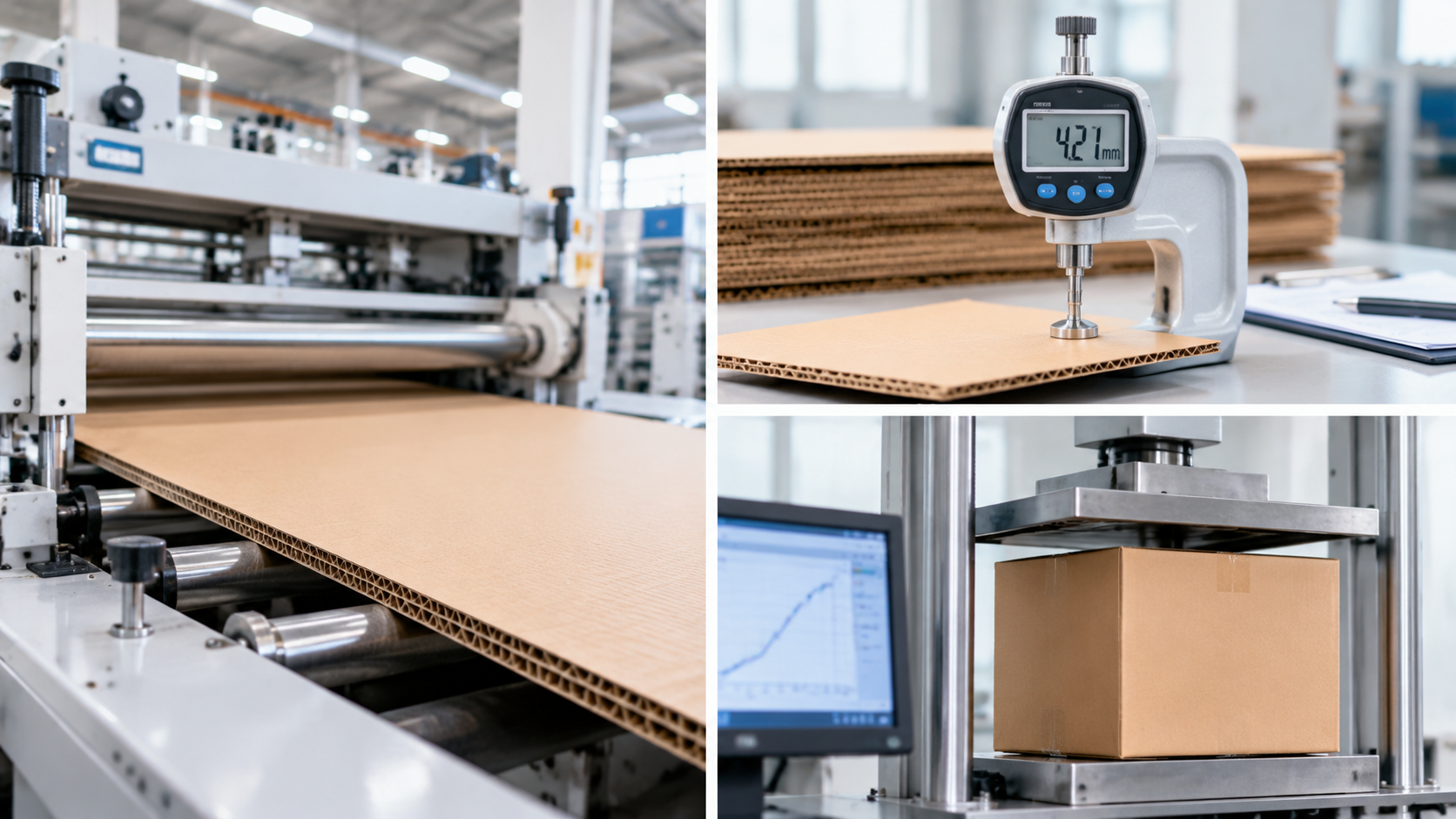
Visual inspection can identify obvious defects, but it cannot establish whether a carton will withstand stacking, transportation, or demanding storage conditions.
Manufacturers should select performance tests based on the intended application.
| Test | What It Measures | Why It Matters |
|---|---|---|
| Edge Crush Test (ECT) | Edgewise compression resistance | Evaluates board strength under edge loading |
| Box Compression Test (BCT) | Finished box compression resistance | Assesses stacking performance |
| Flat Crush Test (FCT) | Resistance to flute crushing | Checks corrugated structure stability |
| Bursting Strength Test | Resistance to rupture under pressure | Evaluates board durability |
| Cobb Test | Water absorptiveness | Helps assess moisture-related risks |
| Adhesion Test | Bonding strength between paper layers | Identifies delamination risks |
| Dimensional Inspection | Length, width, height, and squareness | Ensures packaging compatibility |
The FEFCO testing methods provide an established technical reference for corrugated board and packaging evaluation. They include methods covering ECT, bursting strength, puncture resistance, flat crush, water absorption, adhesive bonding, and finished-box compression.
For finished, filled transport packages, ISO 12048 specifies compression and stacking test methods. Manufacturers should select the applicable method according to the packaging configuration and actual distribution conditions.
Important: Test results should be interpreted against agreed product specifications. Passing one strength test does not automatically mean a carton is suitable for every transportation or storage environment.
One area frequently overlooked in carton quality management is the relationship between machine performance and product consistency.
In an actual carton factory, operators may adjust raw materials and production parameters repeatedly to compensate for unstable equipment. However, frequent manual corrections can increase setup time and introduce additional variations.
The better approach is to identify which machine functions directly influence each quality characteristic.
| Production Equipment | Critical Quality Factors | Potential Defects |
|---|---|---|
| Carton printing machine | Feeding, printing pressure, color registration | Misprints, blurred graphics |
| Slotting machine | Slot position, depth, alignment | Incorrect carton dimensions |
| Die-cutting machine | Die accuracy, cutting pressure | Incomplete cuts, damaged board |
| Box folding machine | Folding alignment and synchronization | Uneven folds, carton distortion |
| Automatic box gluer | Glue position and application consistency | Open seams, weak bonding |
| Carton stitching machine | Staple position and penetration | Loose joints, damaged edges |
A machine may produce acceptable samples during initial setup but develop inconsistencies after extended operation if critical components are worn, poorly adjusted, or inadequately maintained.
For example, unstable feeding can cause printing registration errors. Worn cutting components may produce inconsistent edges. Incorrect synchronization between production sections can affect folding and gluing accuracy.
This is particularly important for factories handling multiple carton sizes and frequent order changes.
Integrated production equipment can help coordinate several converting operations, reducing unnecessary transfers between independent machines.
At Hebei Ouye, the product range includes carton printing machines, carton gluing and stitching machines, die-cutting equipment, and corrugated cardboard production lines. These solutions are designed to address different production requirements, from individual converting operations to integrated carton manufacturing.
A quality management system becomes effective only when inspection responsibilities and production procedures are clearly defined.
The following workflow provides a practical framework for corrugated carton manufacturers.
Before production, confirm:
- Carton dimensions and tolerances.
- Board structure and material specifications.
- Printing artwork and color requirements.
- Cutting, creasing, and folding specifications.
- Gluing or stitching requirements.
- Expected stacking and transportation conditions.
A clearly approved specification prevents misunderstandings between sales, engineering, production, and quality inspection teams.
Check incoming paper and corrugated board against approved specifications.
Record inspection results and identify nonconforming materials before they enter production.
Before mass production, adjust feeding, printing, cutting, creasing, folding, and gluing parameters.
Produce a trial batch and inspect representative samples against the approved design.
Do not rely only on the first visually acceptable carton. Verify critical dimensions, printing alignment, joint quality, and folding performance.
During production, inspect cartons at defined intervals and after significant machine adjustments.
Sampling frequency should reflect production speed, order size, defect history, and customer requirements.
Pay particular attention to defects that may develop gradually, such as changing printing registration, cutting wear, and unstable adhesive application.
Before shipment, verify finished carton appearance, dimensions, assembly quality, and any required performance test results.
Nonconforming products should be identified, isolated, and prevented from entering the finished-goods inventory.
Maintain inspection reports, machine adjustment records, material batch information, and customer feedback.
When recurring defects occur, identify their root causes rather than simply adjusting the machine temporarily.
A structured Plan-Do-Check-Act approach can help factories turn inspection results into measurable process improvements.
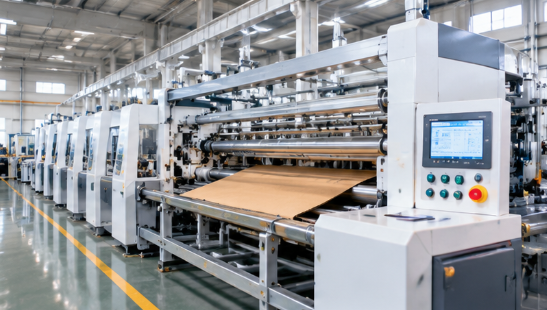
For carton manufacturers planning to expand production capacity, purchasing faster equipment is not necessarily the only objective.
The real challenge is maintaining consistent product quality while increasing output and reducing manual intervention.
Before selecting new carton packaging machinery, evaluate the following factors:
Production compatibility
Confirm that the machine supports the board types, carton dimensions, printing requirements, and order mix used in your factory.
Processing precision
Ask suppliers how feeding accuracy, printing registration, cutting performance, and production synchronization are controlled.
Automation and changeover
For factories handling frequent small-batch orders, evaluate whether automated adjustments and integrated production functions can reduce setup variations.
Maintenance requirements
Review access to wearing parts, routine maintenance procedures, spare parts availability, and technical support.
Installation and operator training
Equipment installation should include commissioning, trial production, parameter adjustment, and operator training.
A real example is OUYE's corrugated box production line project for a large manufacturer in Brazil. The project involved a complete automated production line, followed by overseas installation, integrated commissioning, trial production, and training for operators, maintenance personnel, and management staff.
This illustrates an important principle: equipment performance and production quality depend not only on the machine itself but also on correct installation, commissioning, and ongoing operational management.
Quality control should not stop when a production batch passes final inspection.
Carton manufacturers need to review defect trends and determine whether recurring problems are associated with materials, machine settings, operator practices, or production planning.
Useful performance indicators include:
- First-pass yield.
- Defect rate by production process.
- Material waste rate.
- Customer complaint frequency.
- Machine downtime caused by quality-related issues.
- Rework and rejected carton quantities.
For example, if printing defects increase after frequent order changes, investigate plate setup, ink adjustment, and registration procedures.
If cartons repeatedly fail compression tests, review board specifications, moisture conditions, flute structure, and the actual stacking requirements.
The latest ISO 9001:2026 quality management framework reinforces process control, customer focus, risk-based thinking, performance evaluation, and continual improvement. Manufacturers can use these principles to establish a more systematic approach to production quality.
The objective is not simply to identify defective cartons after production. It is to prevent defects from occurring in the first place.
Ensuring quality control in carton packaging requires coordination between raw material inspection, production process management, standardized performance testing, equipment maintenance, and continuous improvement.
For corrugated box manufacturers, the most effective quality strategy is to establish clear inspection standards at every critical production stage and use suitable machinery to maintain stable processing conditions.
Whether you operate a small carton workshop or a large automated packaging factory, investing in production accuracy and process consistency can reduce material waste, improve delivery reliability, and strengthen customer confidence.
Looking to improve your carton production quality and manufacturing efficiency?
Hebei Ouye Carton Machinery Manufacturer provides carton printing machines, gluing and stitching machines, die-cutting equipment, and integrated production line solutions. Contact our team to discuss your carton specifications, production capacity, automation requirements, and customized equipment configuration.
The most important factors include raw material consistency, corrugated board strength, printing accuracy, cutting and creasing precision, folding and gluing quality, and finished-box performance. Manufacturers should establish inspection checkpoints throughout production rather than relying only on final inspection.
Common tests include Edge Crush Test (ECT), Box Compression Test (BCT), Flat Crush Test (FCT), bursting strength, Cobb water absorption, and adhesive bonding tests. The appropriate tests depend on the board structure and packaging application.
Carton printing machinery affects feeding stability, color registration, ink coverage, and printing clarity. Incorrect pressure, unstable feeding, or poorly maintained components can cause misalignment, blurred graphics, and inconsistent print quality.
Manufacturers can reduce defects by inspecting incoming materials, standardizing machine setup procedures, conducting first-article inspections, monitoring production parameters, maintaining equipment, and recording recurring defects for root-cause analysis.
Machine maintenance helps prevent accuracy deviations caused by component wear, loose connections, unstable feeding, and incorrect mechanical adjustments. Regular maintenance also reduces unexpected downtime and supports consistent production quality.
Important considerations include production capacity, carton size range, board compatibility, printing and cutting accuracy, automation level, changeover requirements, maintenance costs, installation support, and operator training.
An automated production line can improve consistency by coordinating feeding, printing, slotting, cutting, folding, gluing, and stacking operations. However, automation alone does not guarantee quality. Correct machine configuration, maintenance, operator training, and process inspection remain essential.
1. [Pinlong – How to Ensure Quality Control in Carton Packaging] – Original article and foundational quality control topics.
2. [FEFCO – Testing Methods and Recommendations] – Industry testing methods for corrugated board and packaging, including compression, adhesion, and material performance.
3. [ISO 3037:2022 – Corrugated Fibreboard: Determination of Edgewise Crush Resistance] – International standard for ECT measurement.
4. [ISO 3035:2025 – Corrugated Fibreboard: Determination of Flat Crush Resistance] – International standard for flat crush resistance testing.
5. [ISO 12048:1994 – Packaging: Compression and Stacking Tests] – Test methods for compression resistance and stacking performance of complete, filled transport packages.
6. [ISO – Quality Management Systems] – Background on process-based quality management and continual improvement.
7. [ISO 9001:2026 – Quality Management Systems: Requirements] – Current quality management system framework.
8. [Hebei Ouye – Official Website] – Company profile, machinery portfolio, production solutions, and company information.
9. [Hebei Ouye – Corrugated Box Production Line Project for a Large Factory in Brazil] – Company-published project information covering equipment installation, commissioning, and training.


