
Views: 217 Author: Wynne Publish Time: 2026-11-20 Origin: Site


Content Menu
● 1. What Are the Most Common Cutting Errors in Custom-Shaped Corrugated Boxes?
● 2. How Does Corrugated Board Quality Affect Cutting Accuracy?
>> 2.1 Control Board Thickness and Flute Consistency
>> 2.2 Maintain Appropriate Moisture Conditions
>> 2.3 Inspect Flute Direction Before Cutting
● 3. How Can Accurate CAD Design and Die-Making Reduce Cutting Errors?
>> 3.1 Create a Complete and Accurate CAD Cutting File
>> 3.2 Separate Cutting Lines from Creasing Lines
>> 3.3 Improve Cutting Die Manufacturing Accuracy
● 4. Which Cutting Method Is Better for Custom-Shaped Corrugated Boxes?
>> 4.4 Comparison of Three Cutting Methods
● 5. How Should Operators Adjust a Die-Cutting Machine to Prevent Cutting Errors?
>> 5.1 Check the Feeding and Positioning System
>> 5.2 Set the Correct Cutting Pressure
>> 5.3 Maintain Consistent Cutting Speed
>> 5.4 Maintain Cutting Blades and Machine Components
● 6. Establish a First-Article Inspection and In-Process Quality Control System
>> 6.1 Implement a First-Article Inspection Procedure
>> 6.2 Monitor Cutting Quality During Production
>> 6.3 Record Cutting Errors and Corrective Actions
● 7. Expert Insight: A Practical Five-Step Workflow for Reducing Custom Box Cutting Errors
● 8. How Can the Right Carton Machinery Improve Cutting Accuracy?
>> Why Choose Hebei Ouye for Carton Packaging Machinery?
● 9. Frequently Asked Questions About Cutting Errors in Custom-Shaped Corrugated Boxes
>> Q1: What is the most common cause of cutting errors in custom-shaped corrugated boxes?
>> Q2: How can I prevent corrugated cardboard from tearing during die-cutting?
>> Q3: Does corrugated board thickness affect cutting accuracy?
>> Q4: Is flatbed die-cutting better than rotary die-cutting for custom-shaped boxes?
>> Q5: How often should cutting blades be inspected?
>> Q6: How can manufacturers maintain consistent cutting accuracy across multiple production batches?
>> Q7: Can automated carton machinery eliminate cutting errors completely?
Producing custom-shaped corrugated boxes requires more than an accurate cutting machine. Cutting precision depends on the entire production process, including corrugated board quality, CAD design, die-making accuracy, machine setup, feeding stability, and operator control. Even a small cutting deviation can affect box dimensions, folding accuracy, structural strength, and final packaging appearance.
For corrugated packaging manufacturers, reducing cutting errors is particularly important when producing irregular box shapes, customized packaging structures, short production runs, and high-volume orders with strict dimensional requirements. Poor cutting accuracy can lead to material waste, production downtime, additional labor, and rejected cartons.
So, how can manufacturers reduce cutting errors when producing custom-shaped corrugated boxes?
From a production engineering perspective, the most effective approach is to identify the source of each cutting deviation and establish a systematic quality control process. This guide explains the common causes of cutting errors, compares different cutting methods, and provides practical solutions for improving cutting accuracy and production efficiency.
Before adjusting a cutting machine, manufacturers should understand the different types of cutting defects and how they affect finished cartons.
Custom-shaped corrugated boxes often involve complex outlines, multiple folding lines, irregular corners, slots, and special locking structures. These features make cutting accuracy more challenging than producing standard rectangular cartons.
Common Cutting Error | Main Causes | Impact on Finished Boxes |
Incorrect cutting dimensions | Incorrect CAD settings or machine calibration | Box dimensions do not match specifications |
Misaligned cutting lines | Unstable feeding or inaccurate positioning | Uneven edges and inconsistent shapes |
Incomplete cutting | Insufficient cutting pressure or worn blades | Cartons cannot separate cleanly |
Excessive crushing | Excessive pressure or improper machine settings | Reduced board strength |
Rough or torn edges | Dull blades or unsuitable cutting conditions | Poor appearance and reduced processing quality |
Incorrect slot positioning | Die-making errors or registration deviations | Difficult folding and assembly |
Inconsistent cutting depth | Uneven board thickness or pressure distribution | Different cutting results within one production batch |
An important distinction: Cutting errors and creasing errors are not the same. Cutting separates the board along the intended outline, while creasing creates controlled compression lines that allow the carton to fold. Both operations must be accurately coordinated to achieve a correctly assembled box.
One of the most overlooked causes of cutting errors is inconsistent corrugated board quality.
Even when a die-cutting machine is correctly calibrated, variations in board thickness, moisture content, flute structure, and surface condition can affect the cutting result.
Different corrugated board structures have different thicknesses and mechanical properties.
For example:
- E-flute: Commonly used for retail packaging and relatively detailed box designs.
- B-flute: Suitable for general packaging applications requiring a balance between cushioning and printability.
- C-flute: Often selected for shipping cartons requiring greater cushioning.
- Double-wall board: Used for heavier products and applications requiring additional structural protection.
These materials cannot always use identical cutting and creasing settings.
A die designed for one board thickness may produce incorrect crease positions or folding dimensions when used with another material.
Practical recommendations:
1. Measure board thickness before production.
2. Confirm that the board grade and flute combination match the approved packaging design.
3. Check whether the board has uneven thickness across its surface.
4. Adjust cutting and creasing settings according to the actual substrate.
5. Avoid mixing different board specifications within the same production batch.
Corrugated board is made from paper-based materials, so environmental conditions can affect its dimensional stability.
Excessive moisture can soften the board, weaken its structure, and contribute to deformation. Very dry conditions can increase brittleness and make certain cutting and creasing operations less consistent.
Manufacturers should:
- Store corrugated sheets in a clean, dry environment.
- Avoid placing materials directly against damp floors or walls.
- Allow incoming materials to stabilize before processing.
- Keep storage conditions as consistent as practical.
- Inspect warped, curled, or visibly damaged sheets before feeding.
The FEFCO design reference uses standard climatic conditions of 23°C and 50% relative humidity for dimensional measurements. This provides a useful reference when establishing consistent inspection procedures.
Flute direction influences how corrugated board behaves during converting.
The orientation of the flutes affects bending, compression, and folding performance. If the material orientation is inconsistent with the approved design, folding lines may behave differently, even when the cutting dimensions are correct.
Expert recommendation: Include flute direction in the production drawing and material inspection checklist. This is particularly important for irregular packaging structures, reinforced corners, and boxes with multiple folding sections.
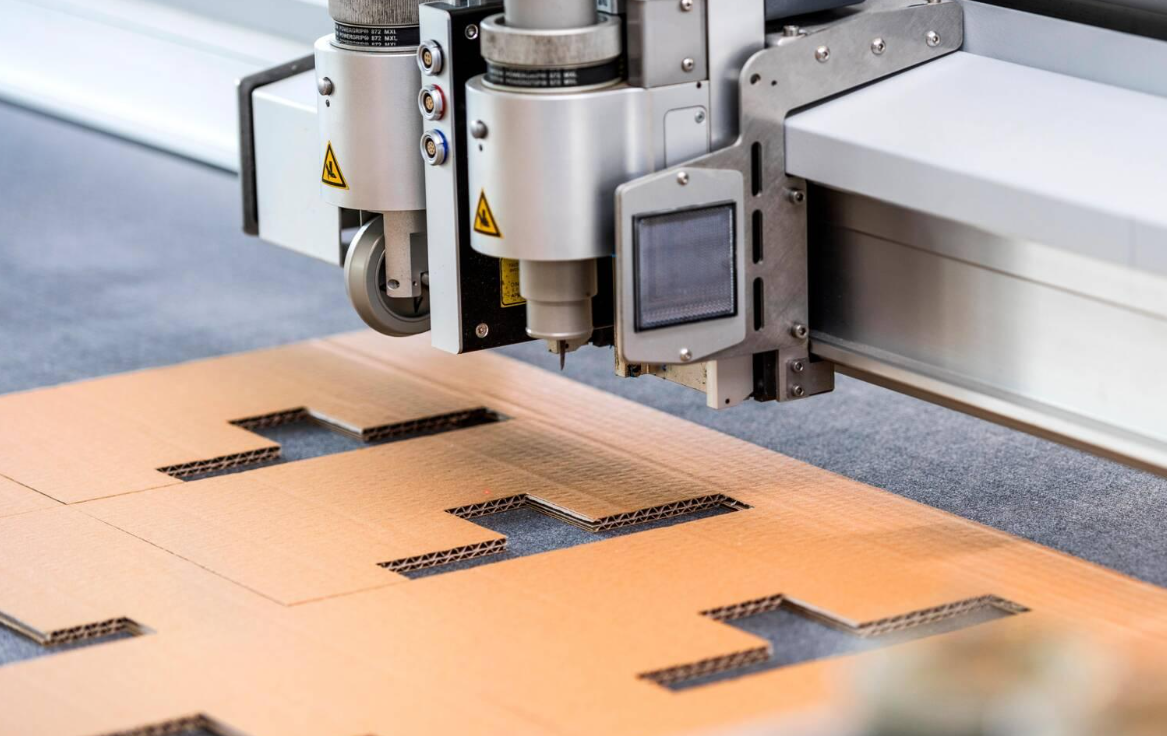
Accurate machine operation starts with an accurate cutting design.
For custom-shaped corrugated boxes, the CAD drawing and cutting die determine the final geometry of the carton blank. Errors introduced during this stage can be repeated throughout the entire production batch.
Before manufacturing the cutting die, engineers should verify the following design elements:
- Overall blank dimensions.
- Cutting-line positions.
- Creasing-line positions.
- Slot dimensions and locations.
- Corner angles and curved edges.
- Glue flap dimensions.
- Locking tabs and interlocking structures.
- Bleed and registration requirements for printed packaging.
A common mistake is to design the flat blank using only the intended finished box dimensions.
However, the thickness of corrugated board and the required crease allowances must also be considered.
For example, when a box is designed to have specific internal dimensions, the distance between crease centers may need to account for board thickness and the folding characteristics of the selected material.
The FEFCO 101 recommendation explains how internal dimensions can be determined from crease-center measurements and applicable creasing allowances.
A professional CAD file should clearly distinguish between different processing operations.
Design Element | Function | Inspection Focus |
Cutting Line | Separates the board along the required shape | Position and cutting completeness |
Creasing Line | Creates a controlled folding area | Position and crease consistency |
Perforation Line | Allows controlled tearing | Perforation spacing and continuity |
Slot Line | Creates openings for assembly or locking | Width, depth, and positioning |
Waste-Removal Area | Allows unwanted board sections to be removed | Clearance and separation |
Using clearly defined line types and colors in the engineering file reduces communication errors between designers, die-makers, and machine operators.
Even a well-designed CAD file cannot compensate for an inaccurately manufactured cutting die.
Before installing a new die, manufacturers should inspect:
- Cutting rule height and alignment.
- Blade sharpness and edge condition.
- Creasing rule dimensions.
- Rule positioning and spacing.
- Die-board flatness.
- Rubber ejection components.
- Overall die dimensions.
Particular attention should be paid to the relationship between cutting rules and creasing rules.
If the creasing channel is unsuitable for the actual board thickness, the material may crack, crush, or fold inaccurately.
The technical guidance published by Iggesund also highlights the importance of creasing rule dimensions, groove width, make-ready thickness, material properties, and die-cutter pressure. Although its guidance focuses on paperboard, these tool-design principles are relevant when evaluating the interaction between creasing tools and packaging substrates.
Not all cutting technologies are equally suitable for custom-shaped packaging.
The choice depends on box complexity, production volume, required precision, tooling investment, and changeover frequency.
Three commonly considered approaches are flatbed die-cutting, rotary die-cutting, and digital cutting.
Flatbed die-cutting uses a flat cutting die and pressing mechanism to cut and crease corrugated sheets.
Advantages:
- Suitable for complex packaging outlines.
- Supports detailed cutting and creasing structures.
- Provides consistent results when tooling and machine settings are properly controlled.
- Suitable for customized box designs and repeat production.
Limitations:
- Requires cutting die preparation.
- Initial setup and tooling changes take time.
- Incorrect pressure distribution can create inconsistent cutting results.
Flatbed die-cutting is often a practical choice for manufacturers producing customized packaging with complex structures and repeat orders.
Rotary die-cutting uses a cylindrical cutting die to process corrugated board continuously.
Advantages:
- Supports high-speed production.
- Suitable for large-volume packaging orders.
- Can be integrated into continuous converting lines.
- Reduces handling between certain production stages.
Limitations:
- Tooling design and cylinder alignment require careful control.
- Complex designs may involve additional tooling considerations.
- Setup changes can be less convenient for frequently changing small batches.
Rotary die-cutting is particularly attractive when production volume and continuous processing are major priorities.
Digital cutting systems use programmable cutting tools instead of a conventional fixed cutting die.
Advantages:
- No traditional cutting die is required for each design.
- Convenient for prototypes and sample production.
- Supports frequent design changes.
- Useful for short production runs and customized packaging.
Limitations:
- Production speed may be lower than dedicated industrial die-cutting systems.
- Tool selection and cutting paths affect processing efficiency.
- Not necessarily the most economical option for large-volume orders.
Comparison Factor | Flatbed Die-Cutting | Rotary Die-Cutting | Digital Cutting |
Cutting Method | Flat die and pressing | Cylindrical die | Programmable cutting tool |
Complex Shapes | Very suitable | Depends on tooling and design | Very suitable |
Large-Volume Production | Suitable | Particularly suitable | Generally less suitable |
Short Production Runs | Suitable with setup considerations | Less flexible | Particularly suitable |
Die Investment | Required | Required | Traditional die generally unnecessary |
Design Changes | Require tooling changes | Require tooling changes | Mainly software adjustments |
Typical Applications | Custom cartons and die-cut boxes | High-volume packaging | Prototypes and small batches |
Which should manufacturers choose?
- Choose flatbed die-cutting when complex box structures, cutting and creasing accuracy, and repeatability are important.
- Choose rotary die-cutting when continuous production and high output are the main priorities.
- Choose digital cutting when design flexibility, prototyping, and small-batch customization are more important than maximum throughput.
The best solution is not necessarily the fastest machine. It is the production method that consistently meets the packaging specifications at an acceptable operating cost.
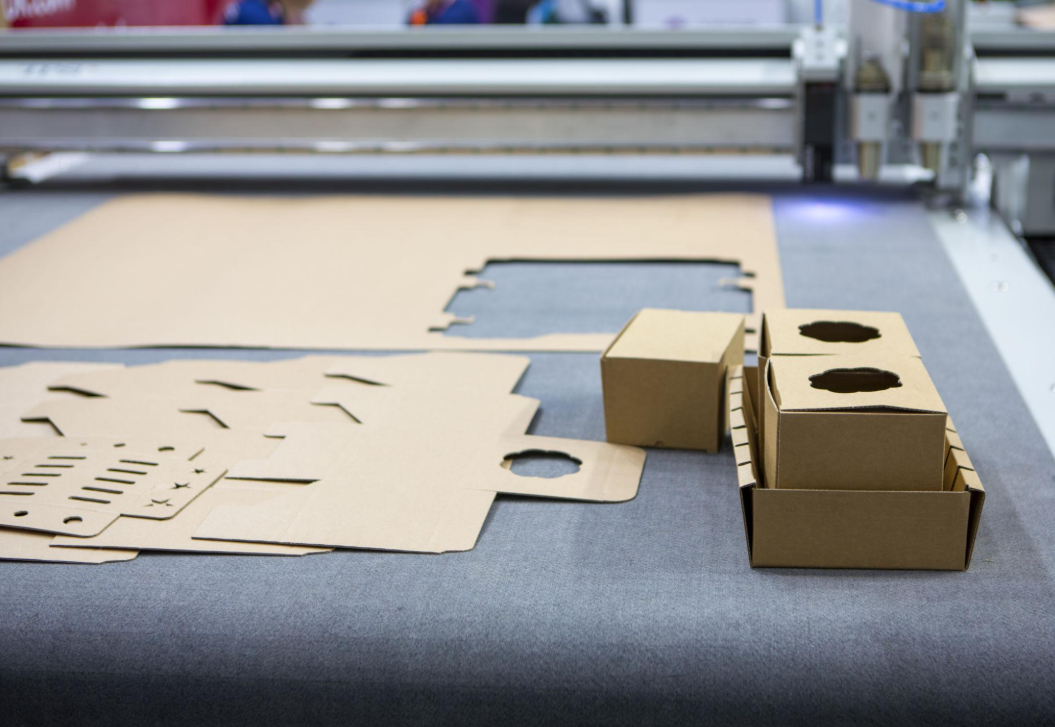
Machine calibration is one of the most important factors in reducing cutting deviations.
A correctly designed die can still produce defective cartons if the feeding system, cutting pressure, registration, or machine components are not properly adjusted.
Incorrect sheet positioning is a common cause of cutting misalignment.
If a corrugated sheet enters the machine at an angle or moves during processing, the cutting die may not align with the intended cutting positions.
Operators should:
1. Check the side guides and front positioning components.
2. Confirm that sheets are fed consistently.
3. Inspect the feeding belts and suction components.
4. Remove dust, paper scraps, and other obstructions.
5. Check whether sheets are slipping or shifting during feeding.
6. Verify print-to-cut registration when printed packaging is involved.
Modern industrial die-cutters may incorporate optical registration and automated sheet-positioning systems. For example, BOBST describes optical registration features and adjustable feeding systems designed to improve sheet alignment and registration accuracy.
Insufficient cutting pressure may leave parts of the board connected.
Excessive pressure can crush the corrugated structure, damage the liner, and affect the quality of folding areas.
The goal is to achieve complete cutting without unnecessary compression of the surrounding board.
A practical adjustment procedure includes:
- Start with the manufacturer's recommended setup for the selected board and tooling.
- Run a small number of test sheets.
- Inspect the cutting edges and creasing areas.
- Identify locations with incomplete cuts or excessive crushing.
- Make controlled adjustments to the pressure or make-ready.
- Repeat the test until the results are consistent.
Avoid increasing overall pressure immediately when only one section has an incomplete cut. The problem may come from uneven tooling, worn rules, or an incorrect make-ready rather than insufficient machine pressure.
Production speed also affects cutting quality.
When operators increase machine speed without checking feeding stability and tooling conditions, sheets may become more difficult to position consistently.
For a new custom-shaped box design, it is better to:
1. Establish a stable baseline speed.
2. Confirm feeding and registration.
3. Verify cutting and creasing quality.
4. Gradually increase production speed.
5. Inspect samples after each significant adjustment.
Production speed should be optimized only after acceptable cutting quality has been established.
Regular maintenance helps prevent gradual deterioration in cutting quality.
Important inspection points include:
- Cutting blade wear and damage.
- Die-board condition.
- Pressure plate and make-ready condition.
- Feeding belt wear.
- Guide alignment.
- Mechanical clearance.
- Lubrication and moving-component condition.
A preventive maintenance schedule is more effective than waiting until cutting errors become visible in finished products.
One of the most effective ways to reduce cutting errors is to inspect the first production samples before allowing the entire order to proceed.
In practical manufacturing, discovering an error after producing several thousand cartons is much more expensive than identifying it during the initial setup.
After installing a new cutting die or changing the packaging design, operators should produce a small sample batch.
The first-article inspection should include:
Inspection Item | Inspection Method | Acceptance Criteria |
Overall dimensions | Measuring tape or calibrated ruler | Matches approved drawing |
Slot positioning | Dimensional measurement | Correct position and spacing |
Cutting edges | Visual inspection | Clean and complete cuts |
Creasing lines | Visual and folding inspection | Consistent and functional creases |
Corner structures | Trial assembly | Correct alignment |
Locking structures | Assembly test | Secure engagement |
Finished box dimensions | Measure assembled carton | Meets agreed specifications |
Manufacturers should establish acceptable dimensional tolerances with customers before production. There is no single tolerance suitable for every custom-shaped corrugated box.
First-article approval does not guarantee that every subsequent sheet will be accurate.
Material changes, machine vibration, blade wear, and feeding deviations can affect production consistency.
A practical inspection schedule may include:
- Before production: Check machine condition, material specifications, and tooling.
- After initial setup: Inspect and approve the first production samples.
- During production: Conduct regular dimensional and visual inspections.
- After adjustments: Recheck the affected cutting areas.
- Before shipment: Perform final sampling and packaging quality checks.
Inspection frequency should be determined according to order volume, product complexity, customer requirements, and historical defect rates.
Experienced manufacturers should maintain production records for recurring defects.
For example:
Recorded Problem | Possible Root Cause | Corrective Action |
Repeated dimensional deviations | Incorrect CAD dimensions | Review and correct the cutting file |
Uneven cutting edges | Worn cutting rules | Inspect and replace tooling |
Inconsistent sheet positioning | Feeding instability | Adjust guides and feeding components |
Crushed folding areas | Excessive pressure | Recheck creasing and pressure settings |
Incorrect print alignment | Registration deviation | Recalibrate the registration system |
This information helps production teams identify recurring problems instead of repeatedly making temporary adjustments.
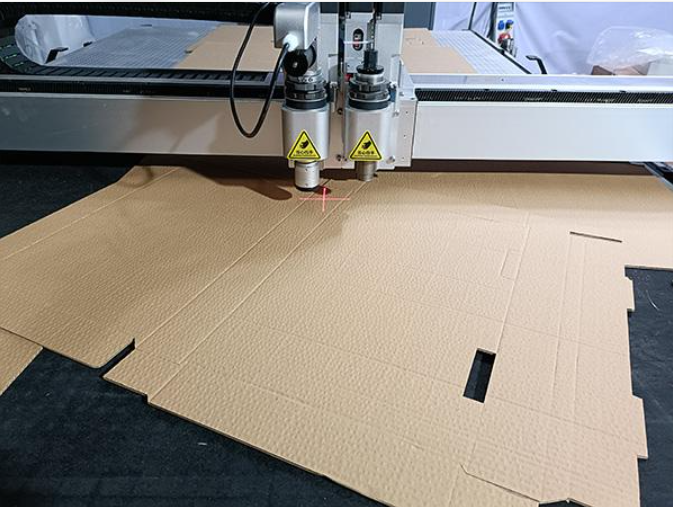
From a production management perspective, cutting accuracy should be controlled through a connected workflow rather than relying on machine operators to correct defects after they occur.
For carton machinery manufacturers and packaging factories, the following five-step process provides a practical starting point.
Step 1: Verify the Packaging Design
Confirm the box dimensions, board specifications, flute direction, cutting lines, creasing lines, and assembly requirements.
Do not release an incomplete or unapproved CAD drawing for die manufacturing.
Step 2: Inspect Materials and Tooling
Measure board thickness, inspect material flatness, and verify that the cutting die matches the approved design.
Check cutting rules, creasing rules, and make-ready conditions before installation.
Step 3: Calibrate the Die-Cutting Machine
Adjust sheet feeding, positioning, registration, and cutting pressure according to the actual material and tooling.
Use test sheets to identify potential deviations before starting full production.
Step 4: Approve the First Production Samples
Measure critical dimensions and test the folding and assembly performance of the finished carton.
Compare the sample against the approved drawing rather than relying only on visual judgment.
Step 5: Monitor and Improve Production
Record inspection results, identify recurring defects, and implement corrective actions.
For repeat orders, retain approved production parameters and tooling records to reduce unnecessary setup variations.
The workflow above is a recommended manufacturing control framework, not a claim of a certified procedure or a measured performance result from a specific factory.
Although material quality, die design, and operator experience are essential, the performance of carton packaging machinery also has a direct influence on production consistency.
When evaluating carton machinery, manufacturers should consider more than the maximum advertised production speed.
Important factors include:
- Feeding accuracy: Can the machine maintain consistent sheet positioning?
- Cutting stability: Can it maintain uniform cutting results throughout a production run?
- Pressure adjustment: Does the machine allow appropriate adjustments for different board specifications?
- Automation: Can automated controls reduce repetitive manual adjustments?
- Changeover efficiency: Can operators switch between different packaging specifications efficiently?
- Maintenance accessibility: Can critical components be inspected and maintained conveniently?
- After-sales support: Are technical assistance, spare parts, and operating guidance available?
For example, BOBST's industrial die-cutting equipment demonstrates how features such as optical registration, adjustable feeding, and automated setup can support accurate converting operations. These are useful reference points when assessing equipment capabilities
Hebei Ouye Carton Machinery Manufacturer specializes in the design and manufacturing of carton packaging machinery, integrating equipment design, production, sales, and after-sales service.
The company focuses on developing intelligent, high-speed, and energy-efficient automated packaging machinery, with an emphasis on addressing practical limitations in existing packaging equipment.
Its products have been supplied to more than 20 countries and regions, including the United Kingdom, Russia, Brazil, Australia, Mexico, Canada, Spain, Malaysia, Thailand, and Vietnam.
For packaging manufacturers looking to improve production processes, selecting suitable machinery is an important part of building a more stable converting operation.
Hebei Ouye welcomes cooperation with carton manufacturers, packaging businesses, and international partners seeking machinery solutions for their production requirements.
Looking to improve your corrugated box production efficiency? Contact Hebei Ouye to discuss your packaging machinery requirements, production challenges, and potential equipment solutions.
Common causes include inaccurate CAD files, incorrect die positioning, inconsistent board thickness, unstable sheet feeding, and improper cutting pressure. Manufacturers should investigate the entire production process rather than immediately assuming the cutting machine is defective.
Use sharp and properly aligned cutting rules, select appropriate tooling, and adjust cutting pressure according to the board specifications. Also inspect material quality and avoid excessive compression during processing.
Yes. Board thickness affects the relationship between cutting rules, creasing rules, and the material. Changes in board thickness may require adjustments to tooling and machine settings to maintain consistent cutting and folding results.
Flatbed die-cutting is often suitable for complex box structures and customized designs. Rotary die-cutting is generally attractive for continuous, high-volume production. The appropriate choice depends on packaging complexity, order volume, tooling requirements, and production efficiency.
Cutting blades should be inspected before production runs and during scheduled maintenance. Additional inspections are recommended when operators notice incomplete cuts, rough edges, increased cutting pressure requirements, or inconsistent cutting results.
Maintain approved CAD files, record material specifications, preserve machine setup parameters, and use standardized first-article inspections. For repeat orders, comparing production samples against previously approved specifications helps identify deviations early.
No. Automation can reduce certain human-related positioning and setup errors, but it cannot eliminate every source of variation. Material inconsistencies, tooling wear, mechanical problems, and incorrect design specifications still require inspection and preventive maintenance.
The following technical references support the discussion of corrugated board production, die-cutting processes, dimensional measurement, registration, and creasing quality.
1\. FEFCO – Technical Specifications for Converting Equipment\
Covers die-cutting inspection, print-to-die-cut registration variation, scoring depth variation, and equipment acceptance criteria.\
[Read FEFCO Technical Specifications]
2\. FEFCO – Corrugated Board Production\
Explains corrugated board manufacturing, material structures, and the differences between regular slotted boxes and die-cut packaging.\
[Read FEFCO Production Overview]
3\. FEFCO – Recommendation No. 101\
Provides guidance on determining internal dimensions of corrugated cases using crease-center measurements and creasing allowances.\
[Read FEFCO Recommendation No. 101]
4\. FEFCO – FEFCO Code, 12th Edition\
Provides standardized corrugated packaging designs, dimensional definitions, and technical drawing conventions.\
5\. BOBST – EXPERTCUT 1.6 | 1.6 PR\
Provides technical information about industrial flatbed die-cutting, corrugated board processing, sheet feeding, and registration features.\
[Read BOBST EXPERTCUT Specifications]
6\. BOBST – MASTERCUT 165 PER\
Describes automated die-cutting, optical registration, positioning, and production setup technologies.\
[Read BOBST MASTERCUT Specifications]
7\. Iggesund – Die-Cutting and Creasing Your Paperboard\
Explains the relationship between creasing tools, groove width, material thickness, and die-cutting pressure.\


